MemoHoney Official Website › Ingredients
IngredientsMemoHoney Ingredients: the six names, and what they actually are
MemoHoney names six ingredients and prints no amount for any of them.
Read in order, the six resolve to four compounds: arginine appears twice, citrulline appears twice, and niacin and beta-alanine appear once each. All four come from the nitric-oxide and sports-nutrition shelf, where the published doses are measured in grams rather than in milligrams.
Below, each of the four compounds in turn, with the dose its published trials used printed beside it.
The six names on the MemoHoney graphic
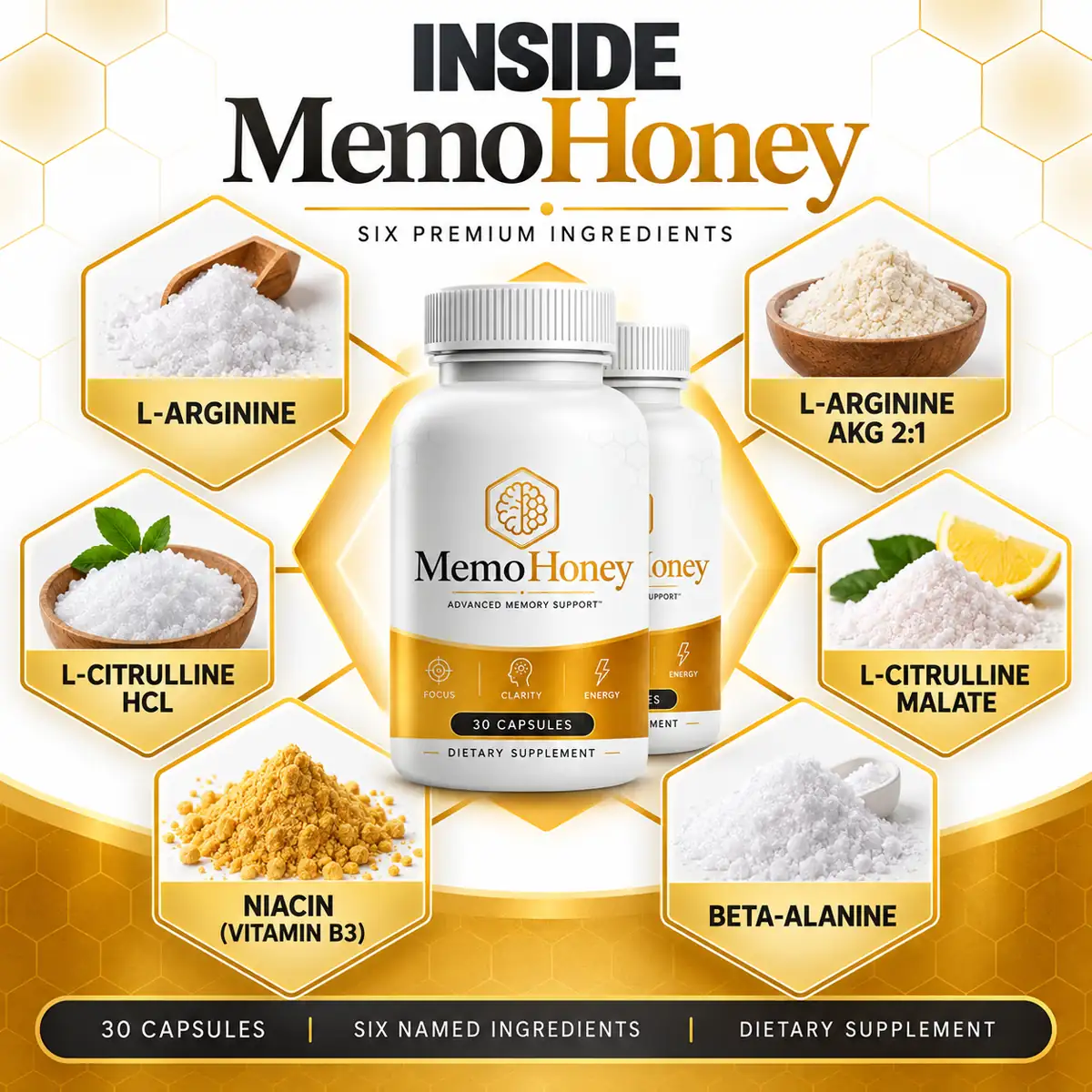
The vendor’s own artwork is the primary source for this page. It is titled “INSIDE MEMOHONEY”, it carries the subtitle “SIX PREMIUM INGREDIENTS”, and it arranges six hexagonal windows around a pair of bottles, each window holding a photograph of a white or yellow powder and a name.
The seller’s page lists the same six with a paragraph of description each. Between the two sources there are six names, twelve descriptions and no figures.
| Name as printed | Compound | Its usual job |
|---|---|---|
| L-Arginine | arginine | the amino acid the body converts to nitric oxide |
| L-Arginine AKG 2:1 Extract | arginine | arginine bound to alpha-ketoglutarate, the pre-workout form |
| L-Citrulline HCL | citrulline | citrulline as a hydrochloride salt, the route that raises arginine furthest |
| L-Citrulline Malate | citrulline | citrulline bound to malic acid, the endurance form |
| Niacin (Vitamin B3) | niacin | an essential B vitamin, and the one ingredient here with an upper limit |
| Beta-Alanine | beta-alanine | the precursor of carnosine, and the source of the pre-workout tingle |
Two pairs, two singles. The list reads a third longer than the formula is.
Naming a salt as its own ingredient is a normal industry practice rather than a trick, and there are real differences between the forms. Citrulline malate brings malic acid with it; citrulline hydrochloride does not. Arginine alpha-ketoglutarate brings alpha-ketoglutarate. What the practice does do is make a four-compound formula look like a six-compound one on a shelf, and a reader comparing this bottle with another is better off counting compounds.
What is in MemoHoney, compound by compound
L-Arginine
the amino acidNo amount on the labelArginine is the direct precursor of nitric oxide, the signalling molecule that relaxes the lining of blood vessels. It is also the ingredient with the most awkward pharmacology on this list, because swallowing it is the least efficient way to raise it. Enzymes in the gut wall and the liver dismantle a large fraction of an oral dose before it reaches the circulation, which is why the head-to-head trial found citrulline at three grams twice a day raised trough plasma arginine further than arginine itself.
The clinical literature is substantial and its results are conditional. A meta-analysis of the endothelial trials found short-term oral arginine improved flow-mediated dilation, but essentially only in people whose baseline dilation was already poor; where vessel function was normal, the effect was not there to find. A later systematic review in cardiovascular and metabolic disease reached a similar conditional place, and an umbrella review of the meta-analyses summarised the field as useful in specific populations rather than generally.
Two things belong beside that. The first is the one memory result: a 2026 pilot randomised thirty-eight older adults with cognitive impairment to 6.4 grams a day of oral L-arginine or placebo for thirty days, and reported improvements in attention, memory and language. It is a pilot, it is small, and its dose is measured in grams. The second is VINTAGE MI, which gave three grams three times daily to patients after a heart attack and was stopped early. That trial is the reason this desk does not describe arginine as harmless at any amount, even though a capsule cannot approach nine grams.
L-Arginine AKG 2:1 Extract
arginine alpha-ketoglutarateNo amount on the labelArginine bound to alpha-ketoglutarate, in a two-to-one ratio. It is a sports-nutrition ingredient with a short and unflattering research record, and it is the clearest single sign of which shelf this formula was assembled from.
The pharmacokinetic and performance trial gave four grams three times a day, twelve grams daily, to trained men for eight weeks. A seven-day study used the same twelve grams and measured blood flow, plasma arginine, nitric oxide metabolites and asymmetric dimethylarginine after resistance exercise. Both are dosed in the same place, and that place is a scoop rather than a capsule.
An acute trial gave a single three-gram dose to resistance-trained and untrained men forty-five minutes before exercise and found no improvement in muscular performance. Three grams is already several times more than a capsule can carry alongside five other ingredients, and it did nothing measurable in that setting. No trial of arginine AKG has measured memory in anybody.
L-Citrulline HCL
citrulline hydrochlorideNo amount on the labelCitrulline is the ingredient with the strongest human evidence on this list, and the evidence is cardiovascular. The kidney converts citrulline into arginine, which is why it raises arginine better than arginine does, and it is the reason this compound displaced arginine in most modern pre-workout formulas.
The blood-pressure meta-analysis pooled randomised trials using three to nine grams a day. Diastolic pressure fell, and the subgroup analysis is the part worth carrying away: the reduction appeared only in the arms dosing at six grams a day or more. A 2025 review of citrulline and watermelon intake in middle-aged and older adults looked at the same question in the age group this product is marketed to.
Closest to the brain, a 2025 trial gave taekwondo athletes 8.8 grams of L-citrulline a day for five consecutive days and measured cerebrovascular function during sprint interval training. It measured flow, not recall. A crossover study gave six grams of citrulline, or six grams of arginine, alongside 520 mg of nitrate, and looked at peripheral and central fatigue during knee extensions. Every one of those numbers is a gram figure.
L-Citrulline Malate
citrulline with malic acidNo amount on the labelThe endurance form: citrulline bound to malic acid, which is itself an intermediate in energy metabolism. It is the version used in most exercise research, and a three-level meta-analysis published in 2026 pooled that literature for performance outcomes.
The trial most relevant to the people this product is aimed at is a pilot in physically active older women: twenty women aged 60 to 75 took three grams a day for six weeks alongside three exercise sessions a week, and lower-limb function improved. Three grams a day is the lowest daily figure anywhere in this reference set, and it is still several times a capsule.
A combined trial of arginine and citrulline malate together dosed by body weight: 0.15 grams per kilogram of arginine and 0.1 grams per kilogram of citrulline malate. For an eighty-kilogram adult that is twelve grams and eight grams. The relevance to this label is that the combination of arginine and citrulline malate has been studied, and it was studied at twenty grams a day between them.
Niacin (Vitamin B3)
nicotinic acidNo amount on the labelThe one essential nutrient in the formula, and the one where a missing number matters most. Niacin has a defined requirement, a defined upper limit and a well-known side effect, and without a printed figure a buyer can total up none of the three.
The Institute of Medicine reference intakes set the adult tolerable upper intake level at 35 mg a day of nicotinic acid from supplements, a figure driven by the flush rather than by organ damage. Above that, the picture changes by scale rather than by kind: the HPS2-THRIVE trial gave 2,000 mg a day with laropiprant to 25,673 patients and recorded serious adverse effects, and a published case report describes hepatotoxicity after large self-administered doses. The FDA Mini-Sentinel assessment reviewed prescription niacin safety across a national database.
Its cognition evidence points the other way and is observational. The Chicago Health and Aging Project found higher dietary niacin associated with a lower rate of incident Alzheimer’s disease and slower cognitive decline; the CARDIA cohort looked at niacin, folate, B6 and B12 intake through young adulthood against cognitive function in midlife. Both studied food. Neither tested a capsule.
Beta-Alanine
the carnosine precursorNo amount on the labelBeta-alanine raises carnosine inside muscle, where carnosine buffers the acid produced by hard effort. It is the reason a scoop of pre-workout makes the face tingle, and it is the ingredient on this list with the least obvious reason to be in a memory capsule.
The International Society of Sports Nutrition position stand sets the working protocol at four to six grams a day for at least four weeks, names paraesthesia as the only reported side effect, and notes that dividing the dose or using a sustained-release form blunts it. A dosing comparison found a sustained-release twelve grams a day raised muscle carnosine faster while reducing the tingle, and a systematic risk assessment pooled the safety data across the literature.
There is a cognitive thread, and it is worth reading carefully because it is thinner than it first looks. One trial gave twelve grams a day for fourteen days before simulated military operational stress and measured cognition, mood and BDNF; a companion study did the same across a 24-hour operation. An imaging trial in twenty 60- to 80-year-olds used 2.4 grams a day and reported changes in fractional anisotropy in the hippocampus and amygdala, which is a measure of white-matter structure rather than of remembering anything. A meta-analysis of histidine-containing dipeptides found an improvement in delayed recall, and the NEAT trial gave carnosine itself at two grams a day for up to twelve weeks and found cognitive improvement in its younger participants.
What the MemoHoney label does not print
One section, once, and the rest of this website does not repeat it.
There is no Supplement Facts panel on the MemoHoney artwork. The front of the label carries the name, the strapline, three marks and the capsule count. The back of the bottle is not shown in the vendor’s photography. The ingredient graphic names six items and prints no figures. The seller’s page describes the same six and prints no figures. That is the whole of the disclosure.
This desk will not estimate one. A guess written in milligrams reads exactly like a fact and would be reproduced as one, and there is no source it could be derived from. What can be said is bounded by physics rather than by marketing: a size-00 capsule holds roughly 0.5 to 0.9 grams of powder in total, and that total is shared across six named inputs and whatever excipient carries them.
Not one of these four compounds has a published human trial at a milligram dose. The lowest daily figure anywhere in the reference list on this page is three grams of citrulline malate, in a six-week trial in older women that also included three exercise sessions a week. The highest is twelve grams of arginine AKG.
That is not an argument that the capsule does nothing. It is the reason this website never says the capsule inherits any of these results.
How to read the MemoHoney ingredient list against another bottle
Count compounds, not names
Six becomes four here. Another bottle listing nine may resolve to six. It is the fastest way to compare two lists honestly.
Look for a panel before you look at the list
A printed Supplement Facts panel with a figure on every line is worth more than a longer list without one. A proprietary blend with a single total is worth less than either.
Ask which shelf the compounds came from
Arginine, citrulline and beta-alanine are pre-workout staples. Ginkgo, bacopa and huperzine are cognition staples. Neither family is dishonest; they simply have different literatures behind them.
Check the dose against the research, not against the competition
Two capsules can both be well under a researched dose. NCCIH puts the same point more generally: a supplement is worth judging on what it contains and how much, not on what its label promises.
MemoHoney ingredients: frequently asked questions
How many ingredients does MemoHoney contain?
Six names appear on the vendor’s graphic, and they resolve to four distinct compounds. L-Arginine and L-Arginine AKG 2:1 are both arginine; L-Citrulline HCL and L-Citrulline Malate are both citrulline. Niacin and beta-alanine are the other two.
Why does MemoHoney list arginine and citrulline twice?
Because they are different salts of the same amino acid, and salts behave a little differently. Citrulline malate is the form used in exercise research; citrulline hydrochloride is the form used where raising plasma arginine is the point. The head-to-head trial compared oral citrulline with oral arginine directly.
Does MemoHoney contain caffeine?
No caffeine is named on the artwork or on the seller’s page. Neither names any stimulant. The energy mark on the label band sits beside focus and clarity as a structure and function phrase rather than as a stimulant claim.
Are the MemoHoney ingredients natural?
All four occur in food. All four in a capsule are manufactured, usually by bacterial fermentation for the amino acids and by synthesis for the niacin. The pack carries a natural ingredients roundel, which is an unregulated phrase rather than a standard.
Which MemoHoney ingredient has the strongest evidence?
Citrulline, and the evidence is about blood pressure and exercise rather than about memory. The meta-analysis pooled trials at three to nine grams a day and found diastolic pressure moved only in the arms at six grams or more.
Sources for the MemoHoney ingredient pages
- Schwedhelm E, Maas R, Freese R, et al. Pharmacokinetic and pharmacodynamic properties of oral L-citrulline and L-arginine: impact on nitric oxide metabolism. Br J Clin Pharmacol. 2008;65(1):51-9. Citrulline 3 g twice daily raised trough plasma arginine furthest. PMID 17662090. https://pubmed.ncbi.nlm.nih.gov/17662090/
- Bai Y, Sun L, Yang T, et al. Increase in fasting vascular endothelial function after short-term oral L-arginine is effective when baseline flow-mediated dilation is low: a meta-analysis of randomized controlled trials. Am J Clin Nutr. 2009;89(1):77-84. PMID 19056561. https://pubmed.ncbi.nlm.nih.gov/19056561/
- Rodrigues-Krause J, Krause M, Rocha IMGD, et al. Association of l-Arginine Supplementation with Markers of Endothelial Function in Patients with Cardiovascular or Metabolic Disorders: A Systematic Review and Meta-Analysis. Nutrients. 2018;11(1):15. PMID 30577559. https://pubmed.ncbi.nlm.nih.gov/30577559/
- McRae MP. Therapeutic Benefits of l-Arginine: An Umbrella Review of Meta-analyses. J Chiropr Med. 2016;15(3):184-9. PMID 27660594. https://pubmed.ncbi.nlm.nih.gov/27660594/
- Schulman SP, Becker LC, Kass DA, et al. L-arginine therapy in acute myocardial infarction: the Vascular Interaction With Age in Myocardial Infarction (VINTAGE MI) randomized clinical trial. JAMA. 2006;295(1):58-64. L-arginine at a goal dose of 3 g three times daily for six months; the trial was stopped early. PMID 16391217. https://pubmed.ncbi.nlm.nih.gov/16391217/
- Teotia S, Rana AK, Gupta V. Comparison of the Safety and Efficacy of Oral L-arginine for the Treatment of Cognitive Impairment in Older Adults: A Prospective, Randomized, Placebo-Controlled Pilot Study. Cureus. 2026;18(7):e112987. Thirty-eight participants, oral L-arginine 6.4 g/day for 30 days. PMID 42621366. https://pubmed.ncbi.nlm.nih.gov/42621366/
- Campbell B, Roberts M, Kerksick C, et al. Pharmacokinetics, safety, and effects on exercise performance of L-arginine alpha-ketoglutarate in trained adult men. Nutrition. 2006;22(9):872-81. Four grams three times daily, 12 g/day for eight weeks. PMID 16928472. https://pubmed.ncbi.nlm.nih.gov/16928472/
- Willoughby DS, Boucher T, Reid J, et al. Effects of 7 days of arginine-alpha-ketoglutarate supplementation on blood flow, plasma L-arginine, nitric oxide metabolites, and asymmetric dimethyl arginine after resistance exercise. Int J Sport Nutr Exerc Metab. 2011;21(4):291-9. Twelve grams a day. PMID 21813912. https://pubmed.ncbi.nlm.nih.gov/21813912/
- Wax B, Kavazis AN, Webb HE, et al. Acute L-arginine alpha ketoglutarate supplementation fails to improve muscular performance in resistance trained and untrained men. J Int Soc Sports Nutr. 2012;9(1):17. A single 3,000 mg dose. PMID 22510253. https://pubmed.ncbi.nlm.nih.gov/22510253/
- Barkhidarian B, Khorshidi M, Shab-Bidar S, et al. Effects of L-citrulline supplementation on blood pressure: A systematic review and meta-analysis. Avicenna J Phytomed. 2019;9(1):10-20. Doses ran 3 to 9 g/day, and only the arms at 6 g/day or more moved diastolic pressure. PMID 30788274. https://pubmed.ncbi.nlm.nih.gov/30788274/
- Luo P, Chen J, Liu K, et al. Does l-citrulline supplementation and watermelon intake reduce blood pressure in middle-aged and older adults? A systematic review and meta-analysis of randomized controlled trials. Clin Nutr ESPEN. 2025;69:653-664. PMID 40789388. https://pubmed.ncbi.nlm.nih.gov/40789388/
- Li A, Li H, Chen J. The effects of L-citrulline supplementation on cerebrovascular function during sprint interval training in taekwondo athletes. J Exerc Sci Fit. 2025;23(3):222-228. Participants took 8.8 g of L-citrulline daily for five days. PMID 40474881. https://pubmed.ncbi.nlm.nih.gov/40474881/
- Le Roux-Mallouf T, Laurent J, Besset D, et al. Effects of acute nitric oxide precursor intake on peripheral and central fatigue during knee extensions in healthy men. Exp Physiol. 2019;104(7):1100-1114. Six grams of citrulline and six grams of arginine, each beside 520 mg of nitrate. PMID 31004378. https://pubmed.ncbi.nlm.nih.gov/31004378/
- Wang X, Fan X, Chang J, et al. Effects of Citrulline Malate Supplementation on Exercise Performance: A Systematic Review and Three-Level Meta-Analysis. Nutrients. 2026;18(12):1948. PMID 42356270. https://pubmed.ncbi.nlm.nih.gov/42356270/
- Ramos-Hernandez R, Pascual-Fernandez J, Alvarez-Pardo S, et al. Short-term citrulline malate supplementation enhances lower-limb function in physically active older women: A pilot randomized controlled trial. Clin Nutr ESPEN. 2026;74:103356. Twenty women aged 60-75, 3 g/day for six weeks alongside exercise. PMID 42162613. https://pubmed.ncbi.nlm.nih.gov/42162613/
- Selvaraj S, Petridis L, Majtenyi H, et al. Acute effects of combined supplementation of L-arginine and citrulline malate on aerobic, anaerobic, and CrossFit exercise performance. Sci Rep. 2025;15(1):33067. Arginine at 0.15 g per kg of body weight and citrulline malate at 0.1 g per kg. PMID 41006371. https://pubmed.ncbi.nlm.nih.gov/41006371/
- Institute of Medicine (US) Standing Committee on the Scientific Evaluation of Dietary Reference Intakes. Niacin. In: Dietary Reference Intakes for Thiamin, Riboflavin, Niacin, Vitamin B6, Folate, Vitamin B12, Pantothenic Acid, Biotin, and Choline. Washington (DC): National Academies Press; 1998. The adult tolerable upper intake level is 35 mg/day of nicotinic acid from supplements. NCBI Bookshelf NBK114304. https://www.ncbi.nlm.nih.gov/books/NBK114304/
- Morris MC, Evans DA, Bienias JL, et al. Dietary niacin and the risk of incident Alzheimer's disease and of cognitive decline. J Neurol Neurosurg Psychiatry. 2004;75(8):1093-9. An observational study of niacin from FOOD, not from capsules. PMID 15258207. https://pubmed.ncbi.nlm.nih.gov/15258207/
- Qin B, Xun P, Jacobs DR Jr, et al. Intake of niacin, folate, vitamin B-6, and vitamin B-12 through young adulthood and cognitive function in midlife: the Coronary Artery Risk Development in Young Adults (CARDIA) study. Am J Clin Nutr. 2017;106(4):1032-1040. PMID 28768650. https://pubmed.ncbi.nlm.nih.gov/28768650/
- Haynes R, Valdes-Marquez E, Hopewell JC, et al. Serious Adverse Effects of Extended-release Niacin/Laropiprant: Results From the Heart Protection Study 2-Treatment of HDL to Reduce the Incidence of Vascular Events (HPS2-THRIVE) Trial. Clin Ther. 2019;41(9):1767-1777. Niacin-laropiprant at 2,000/40 mg a day in 25,673 patients. PMID 31447131. https://pubmed.ncbi.nlm.nih.gov/31447131/
- Durham SH, Covington EW, Clemmons KJ. Hepatotoxicity upon using niacin to pass a drug test: A case report. J Am Pharm Assoc (2003). 2018;58(5):564-567. PMID 29941333. https://pubmed.ncbi.nlm.nih.gov/29941333/
- Gagne JJ, Houstoun M, Reichman ME, et al. Safety assessment of niacin in the US Food and Drug Administration's mini-sentinel system. Pharmacoepidemiol Drug Saf. 2018;27(1):30-37. PMID 29108128. https://pubmed.ncbi.nlm.nih.gov/29108128/
- Trexler ET, Smith-Ryan AE, Stout JR, et al. International society of sports nutrition position stand: Beta-Alanine. J Int Soc Sports Nutr. 2015;12:30. Four to six grams daily for at least four weeks, with paraesthesia the one reported side effect. PMID 26175657. https://pubmed.ncbi.nlm.nih.gov/26175657/
- Dolan E, Swinton PA, Painelli VS, et al. A Systematic Risk Assessment and Meta-Analysis on the Use of Oral beta-Alanine Supplementation. Adv Nutr. 2019;10(3):452-463. PMID 30980076. https://pubmed.ncbi.nlm.nih.gov/30980076/
- Church DD, Hoffman JR, Varanoske AN, et al. Comparison of Two beta-Alanine Dosing Protocols on Muscle Carnosine Elevations. J Am Coll Nutr. 2017;36(8):608-616. A sustained-release 12 g/day protocol raised muscle carnosine faster while blunting the tingle. PMID 28910200. https://pubmed.ncbi.nlm.nih.gov/28910200/
- Varanoske AN, Wells AJ, Boffey D, et al. Effects of High-Dose, Short-Duration beta-Alanine Supplementation on Cognitive Function, Mood, and Circulating Brain-Derived Neurotropic Factor (BDNF) in Recreationally-Active Males Before Simulated Military Operational Stress. J Diet Suppl. 2021;18(2):147-168. Fourteen days at 12 g a day. PMID 32138563. https://pubmed.ncbi.nlm.nih.gov/32138563/
- Varanoske AN, Wells AJ, Kozlowski GJ, et al. Effects of beta-alanine supplementation on physical performance, cognition, endocrine function, and inflammation during a 24 h simulated military operation. Physiol Rep. 2018;6(24):e13938. PMID 30565426. https://pubmed.ncbi.nlm.nih.gov/30565426/
- Ostfeld I, Zamir A, Ben-Zeev T, et al. beta-Alanine supplementation improves fractional anisotropy scores in the hippocampus and amygdala in 60-80-year-old men and women. Exp Gerontol. 2024;194:112513. Twenty participants at 2.4 g a day. PMID 38971131. https://pubmed.ncbi.nlm.nih.gov/38971131/
- Bell SM, Hariharan R, Laud PJ, et al. Histidine-containing dipeptide supplementation improves delayed recall: a systematic review and meta-analysis. Nutr Rev. 2024;82(10):1372-1385. PMID 38013229. https://pubmed.ncbi.nlm.nih.gov/38013229/
- O'Toole TE, Amraotkar AR, Gao H, et al. Carnosine supplementation improves cognitive outcomes in younger participants of the NEAT trial. Neurotherapeutics. 2025;22(2):e00541. Carnosine capsules at 2 g daily for up to 12 weeks. PMID 39919936. https://pubmed.ncbi.nlm.nih.gov/39919936/
- Using Dietary Supplements Wisely. National Center for Complementary and Integrative Health, National Institutes of Health. https://www.nccih.nih.gov/health/using-dietary-supplements-wisely
Order MemoHoney from the official website
Four compounds, one capsule, one time of day. The formula is simple and the disclosure is thin, and both of those are worth deciding about before ordering rather than after.
From $158 for two bottles to $294 for six, with 60 days on all three
Choose A MemoHoney PackSwallowed whole, one a day, 30 to a bottle. Batch MEM-26/ME-8729, shipped from the United States.