MemoHoney Official Website › Benefits
BenefitsMemoHoney Benefits: What the Bottle and Sales Page Say
By the MemoHoney Team at Memohoneye · Physician review: Dr. Taz Bhatia, MD · Updated
The MemoHoney bottle names four benefits, and the sales page adds five more.
This page keeps the two lists apart, so you can see which words come from the bottle and which come from the seller.
See the compounds behind them on the ingredients page.
Reading a benefits page is mostly an exercise in noticing which sentence came from which surface.
What the MemoHoney bottle itself claims
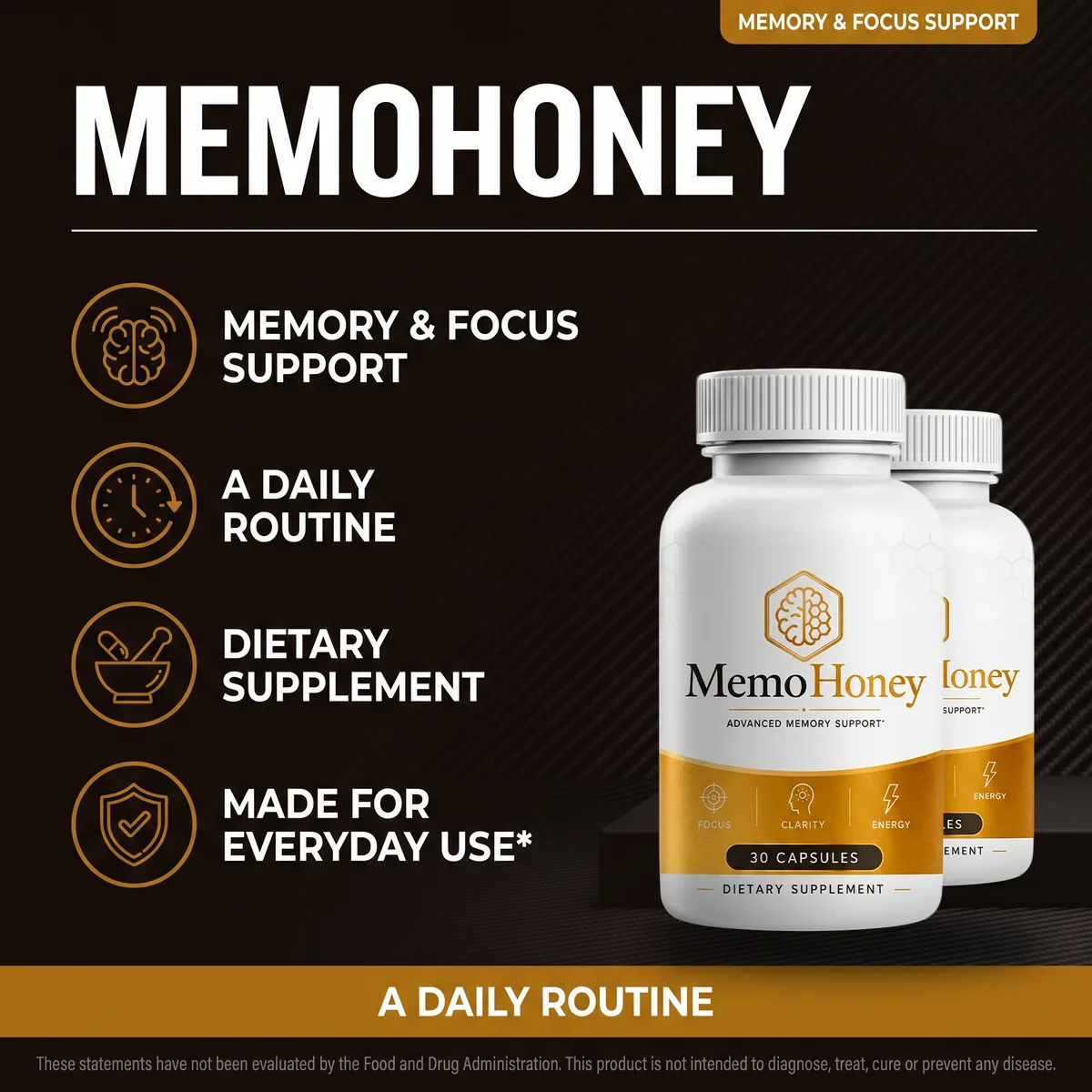
Four phrases, and they are short enough to print in full.
“Advanced Memory Support” runs under the wordmark on the front of the bottle. “Memory and Focus Support” is the banner on the vendor’s listing artwork. Across the amber band sit three marks reading focus, clarity and energy. The fourth is “made for everyday use”, which is about the routine rather than about an effect.
- Advanced Memory Support
- Memory & Focus Support
- Focus, Clarity, Energy
- Made For Everyday Use
These are structure and function statements. In the United States a dietary supplement may describe support for a normal body function without making a disease claim, provided the label carries the disclaimer about the Food and Drug Administration, which this one does and this website repeats on every page.
What the four phrases have in common is that none of them promises a result. Support, focus, clarity, energy and everyday use are directional words. That is the correct register for the product and it is the register the rest of this website keeps.
What the MemoHoney sales page adds
The seller’s own page goes considerably further. Its five sentences are printed below exactly as the seller writes them, with what each one would need in order to be a finding rather than a phrase.
| The seller’s sentence | What it would take to be a finding |
|---|---|
| Enhance memory function and support overall cognitive health | A randomised trial of this capsule, at this dose, with a validated memory endpoint. None exists for this product. |
| Protect the brain from oxidative stress and improve mental clarity | A measured antioxidant endpoint in human brain tissue. No trial of these four compounds has measured one. |
| Boost neural communication and promote better brain performance | A measure of neural transmission changing with the capsule. Nothing in the literature on these compounds does this. |
| Support long-term brain health and improve focus and concentration | A long-term trial with a cognitive endpoint, of the kind COSMOS-Mind ran for three years. |
| Optimize neurotransmitter production and contribute to a sharper, more agile mind | Neurotransmitter production measured in a living person. This has not been done for any of these ingredients. |
The right-hand column is the standard, not a rebuttal of the product.
The claim about optimising neurotransmitter production, and the claim about protecting the brain from oxidative stress. Both appear on the seller’s page. Neither has an endpoint anybody has measured in a person taking any of these four compounds, so both are reported on this website as the seller’s wording and are not used anywhere else on it.
What the four MemoHoney compounds have actually been shown to do
Set against those claims, here is the evidence that does exist, at the doses it exists at. All of it is vascular or muscular, and that is the point.
| Compound | Shown to | At | In |
|---|---|---|---|
| Citrulline | Lower diastolic blood pressure | 6 g/day or more | a meta-analysis of randomised trials |
| Citrulline malate | Improve exercise performance measures | 3 g/day and up | a three-level meta-analysis |
| Arginine | Improve flow-mediated dilation where it was poor | 3 to 24 g/day | a meta-analysis of randomised trials |
| Arginine | Improve attention, memory and language in one pilot | 6.4 g/day | a 38-person placebo-controlled pilot |
| Beta-alanine | Raise muscle carnosine and buffer acid | 4 to 6 g/day | the ISSN position stand |
| Niacin | Serve as an essential nutrient | 16 mg/day for men, 14 for women | the Institute of Medicine reference intakes |
Every dose in the third column is a daily amount from the trial itself.
One row in that table is about memory, and it is a pilot. That is the honest state of the evidence for this ingredient set, and it is why this website describes the bottle’s four phrases as claims rather than as findings.
For scale, the two trials in this reference set built to detect a cognitive change were COSMOS-Mind, which ran three years, and its clinic sub-cohort and meta-analysis. A multivitamin produced a small benefit; cocoa extract at 500 mg of flavanols a day produced none. That is the size of trial the field needs.
What MemoHoney does not do
One list, once, and it belongs on a benefits page rather than scattered through the site.
- It is not a treatment for dementia, Alzheimer’s disease or mild cognitive impairment, and it is not a substitute for being assessed.
- It is not a stimulant. No caffeine is named on the artwork or on the seller’s page.
- It does not replace sleep, which is where memory is consolidated and which moves day-to-day recall more than any capsule in this category has been shown to.
- It carries no printed amount for any ingredient, so it cannot be compared milligram for milligram with any other bottle.
- It is not FDA-approved. No dietary supplement is.
MemoHoney benefits: frequently asked questions
What are the benefits MemoHoney claims?
Four phrases appear on the artwork: advanced memory support, memory and focus support, the three marks reading focus, clarity and energy, and made for everyday use. Those are structure and function statements and they are the ceiling on this website.
Does MemoHoney improve memory?
The bottle claims support for memory. No trial of arginine, citrulline, niacin or beta-alanine at a capsule dose has measured memory. The closest published result is a thirty-eight-person pilot of 6.4 grams of arginine a day, and a pilot at a gram dose is not a result a capsule inherits.
Does MemoHoney give you energy?
The label band carries an energy mark. Niacin is a precursor of NAD, which every cell uses in energy metabolism, so the word is not arbitrary. No stimulant is named on the artwork or on the seller’s page, and this is not a caffeine product.
Is MemoHoney a treatment for anything?
No. It is a dietary supplement, it is not FDA-approved, and it is not intended to diagnose, treat, cure or prevent any disease. Nothing on this website describes it as a treatment.
Sources for the MemoHoney claims
- Barkhidarian B and colleagues, Avicenna J Phytomed 2019;9(1):10-20 — Effects of L-citrulline supplementation on blood pressure: A systematic review and meta-analysis; what it tested: doses ran 3 to 9 g/day, and only the arms at 6 g/day or more moved diastolic pressure (PubMed 30788274)
- Wang X and colleagues, Nutrients 2026;18(12):1948 — Effects of Citrulline Malate Supplementation on Exercise Performance: A Systematic Review and Three-Level Meta-Analysis (PubMed 42356270)
- Bai Y and colleagues, Am J Clin Nutr 2009;89(1):77-84 — Increase in fasting vascular endothelial function after short-term oral L-arginine is effective when baseline flow-mediated dilation is low: a meta-analysis of randomized controlled trials (PubMed 19056561)
- Teotia S, Rana AK, Gupta V, Cureus 2026;18(7):e112987 — Comparison of the Safety and Efficacy of Oral L-arginine for the Treatment of Cognitive Impairment in Older Adults: A Prospective, Randomized, Placebo-Controlled Pilot Study; what it tested: thirty-eight participants, oral L-arginine 6.4 g/day for 30 days (PubMed 42621366)
- Trexler ET and colleagues, J Int Soc Sports Nutr 2015;12:30 — International society of sports nutrition position stand: Beta-Alanine; what it tested: four to six grams daily for at least four weeks, with paraesthesia the one reported side effect (PubMed 26175657)
- Institute of Medicine (US) committee on Dietary Reference Intakes, 1998 — the niacin chapter of Dietary Reference Intakes for Thiamin, Riboflavin, Niacin, Vitamin B6, Folate, Vitamin B12, Pantothenic Acid, Biotin, and Choline (National Academies Press); it sets the adult tolerable upper intake for nicotinic acid from supplements at 35 mg a day (NCBI Bookshelf NBK114304)
- Baker LD and colleagues, Alzheimers Dement 2023;19(4):1308-1319 — Effects of cocoa extract and a multivitamin on cognitive function: A randomized clinical trial; what it tested: cocoa extract at 500 mg/day of flavanols, and a commercial multivitamin, over three years (PubMed 36102337)
- Vyas CM and colleagues, Am J Clin Nutr 2024;119(3):692-701 — Effect of multivitamin-mineral supplementation versus placebo on cognitive function: results from the clinic subcohort of the COcoa Supplement and Multivitamin Outcomes Study (COSMOS) randomized clinical trial and meta-analysis of 3 cognitive studies within COSMOS (PubMed 38244989)
- National Center for Complementary and Integrative Health, National Institutes of Health — Dietary Supplements and Cognitive Function, Dementia, and Alzheimer's Disease: What the Science Says, the agency’s own web page (www.nccih.nih.gov)
Order MemoHoney with the claims in view
Four phrases on a bottle, five on a sales page, and one pilot trial at a gram dose. A buyer who has read all three is in a better position than one who has read only the third.
From $158 for two bottles to $294 for six, with 60 days on all three
Choose A MemoHoney PackSwallowed whole, one a day, 30 to a bottle. Batch MEM-26/ME-8729, shipped from the United States.