MemoHoney Official Website › Blog › Six Names, Four Compounds
Six Names, Four Compounds: How To Count An Ingredient List
A supplement list that reads six items long can easily be a four-ingredient formula. The trick is not dishonest and it is not even hidden, but almost nobody counts the way that reveals it, and once you do you will never read a shelf the same way again.
Why an ingredient list is usually longer than the formula
Pick up any bottle on a supplement shelf and the number printed on the front is almost always a count of names. Twelve ingredients. Nine actives. Six premium ingredients. That number sells, because a longer list reads as a more complete product, and it is the easiest figure on a label to inflate without writing anything untrue.
The inflation happens in two ordinary ways. The first is that a single compound appears twice as two different salts, which is what this article is about. The second is that a nutrient and its carrier are listed separately, so magnesium and the glycinate it is bound to occupy two lines. Neither is a lie. Both make a formula look wider than it is.
The reason it matters is not moral. It is that a buyer comparing two bottles is almost always comparing the wrong quantity. A nine-name formula with five compounds in it is a narrower product than a six-name formula with six, and the labels say the opposite.
What a salt actually is, in one paragraph
Amino acids are unstable in their raw form and unpleasant to handle. To make them into a powder that can be weighed, shipped and encapsulated, a manufacturer binds them to something. Hydrochloric acid gives a hydrochloride. Malic acid gives a malate. Alpha-ketoglutarate gives an AKG. The resulting powder is a salt: the amino acid plus a partner, in a fixed ratio.
Inside the body the salt dissociates almost immediately and the amino acid goes about its business. The partner is not inert — malic acid is itself an intermediate in energy metabolism, and a two-to-one AKG ratio means a meaningful share of the powder's weight is alpha-ketoglutarate rather than arginine — but for most purposes the salt is a delivery decision rather than a second ingredient.
- A salt changes the weight. A gram of citrulline malate is not a gram of citrulline. Part of that gram is malic acid, which is why exercise trials specify the salt rather than the amino acid.
- A salt can change the absorption. Hydrochlorides dissolve readily; some other forms are chosen for stability rather than for uptake.
- A salt does not change the compound. Once it is in solution, citrulline is citrulline whichever acid brought it.
Counting the MemoHoney list
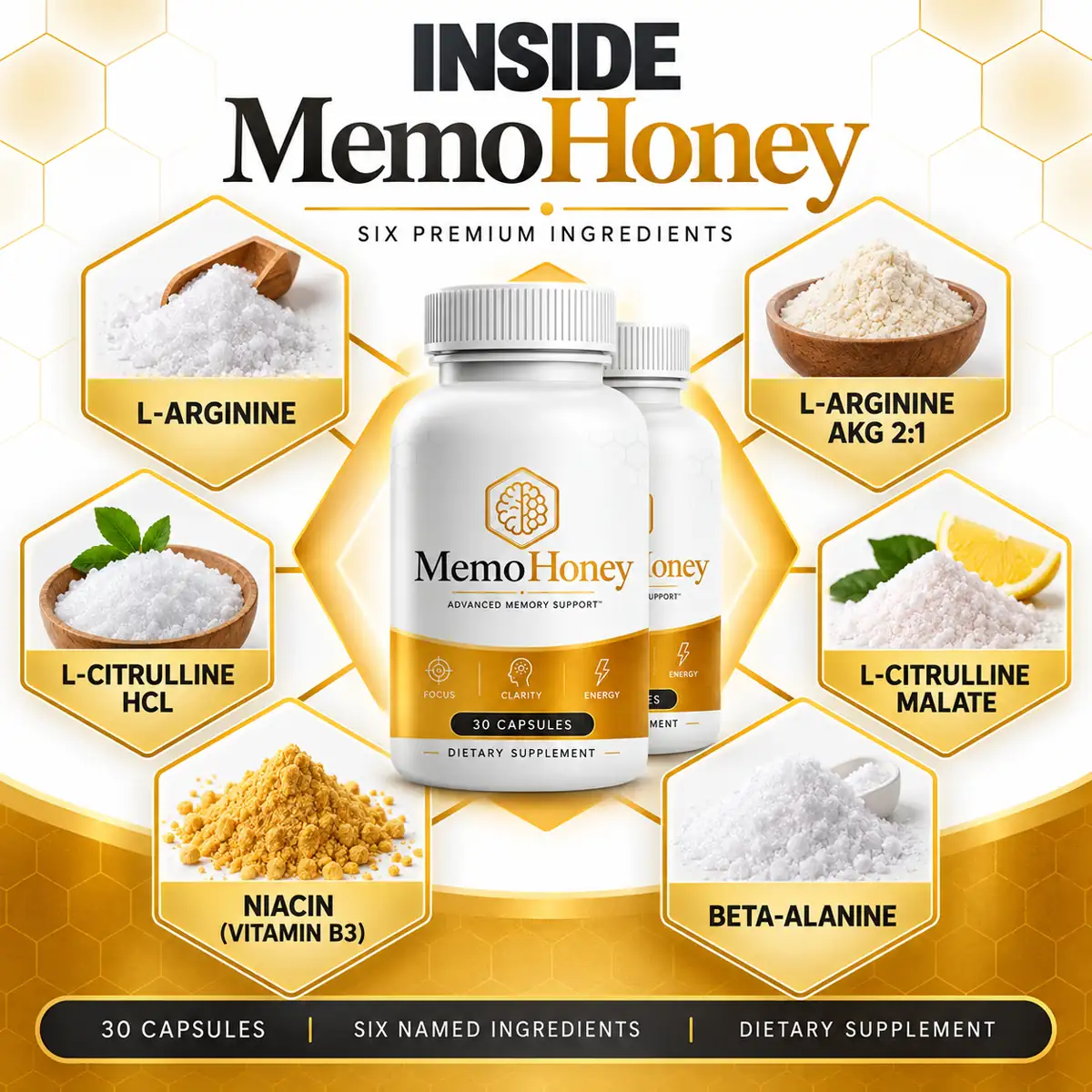
The vendor's own graphic names six ingredients, and this is what happens when you sort them by compound rather than by line.
| Name as printed | Compound | What the partner is | Line count |
|---|---|---|---|
| L-Arginine | Arginine | None, the free amino acid | 1 |
| L-Arginine AKG 2:1 Extract | Arginine | Alpha-ketoglutarate, two parts to one | 2 |
| L-Citrulline HCL | Citrulline | Hydrochloride | 3 |
| L-Citrulline Malate | Citrulline | Malic acid | 4 |
| Niacin (Vitamin B3) | Niacin | None, a vitamin | 5 |
| Beta-Alanine | Beta-alanine | None, the free amino acid | 6 |
Six lines, four compounds. Arginine occupies two of the six and citrulline another two.
Four compounds: arginine, citrulline, niacin, beta-alanine. The list reads a third longer than the formula is, and that is before anybody asks how much of each is present, which on this particular label is a question with no answer at all.
There is a defensible reason to carry both citrulline salts. The exercise literature is built on citrulline malate specifically, while the pharmacokinetic work that established citrulline as the better way to raise plasma arginine used plain L-citrulline. A formulator who wants both literatures behind a product has an argument for including both forms. Whether a single capsule can hold enough of either to matter is a different question, and it is answered on the ingredients page.
- Sort the list by compound before you compare it with anything else.
- Two salts of one amino acid are one ingredient written twice.
- A vitamin and a mineral are always their own compound.
- The number on the front of the bottle is a count of lines, not of substances.
See the MemoHoney formula counted properly
The ingredients page sorts all six names into four compounds and prints the dose each one's published research used beside it.
From $158 for two bottles to $294 for six, with 60 days on all three
Choose A MemoHoney PackSwallowed whole, one a day, 30 to a bottle. Batch MEM-26/ME-8729, shipped from the United States.
When the duplication matters, and when it does not
Not every doubled name is a problem, and treating them all as one is as unhelpful as ignoring them.
When it barely matters
- When the label prints an amount for every line. Two citrulline rows at 500 mg each are simply a gram of citrulline split across two salts, and a reader can add them up.
- When the two forms genuinely have separate literatures, which is the case for citrulline malate against plain citrulline.
- When the partner does something. Malic acid is not filler and alpha-ketoglutarate is not filler; both have their own small research records.
When it matters a great deal
- When no amounts are printed. Then a reader cannot tell whether the two rows are a gram between them or a pinch, and the extra name is pure width.
- When the front of the bottle sells the count. Six premium ingredients is a marketing claim built on the line count rather than on the formula.
- When you are comparing two bottles. A four-compound product and a six-compound product can print the same headline number.
- When the compounds all come from the same family. Four of these six lines are the two halves of one nitric-oxide pathway.
The other way a list gets wider: the proprietary blend
Salt duplication is the polite version of the problem. The blunt version is the proprietary blend, and it is worth knowing about because the two often appear on the same bottle and a reader who spots one should immediately check for the other.
A proprietary blend is a group of ingredients printed under a single total. The panel says something like Cognitive Matrix, 750 mg, and then lists eight names beneath it in descending order of weight. The total is real and the order is real. The split between the eight is not disclosed, and a formula can put 740 mg into the first name and ten milligrams across the other seven without printing anything untrue.
Regulation allows it and there is even a defensible reason for it, which is that a formulator who publishes an exact split has handed a competitor the recipe. The cost is borne entirely by the buyer, who is being asked to take the interesting part on trust.
- Descending order is the one clue. The first name in a blend has the most of it, and the last name may be present in a quantity a laboratory would struggle to detect.
- A blend plus salt duplication compounds the problem. Eight names in a blend can be five compounds, at an unknown split, under one total.
- A blend with a small total is the clearest signal of all. Eight ingredients under 300 mg cannot each be a researched dose of anything.
- No panel at all is a third category. It is neither a blend nor a disclosure, and it is what this particular label does.
Set the three side by side and there is a clear hierarchy. A full panel with a figure on every line can be audited by anybody. A proprietary blend can be partly audited: the total is known and the order is known. A label with no panel gives a reader the names and nothing else, and the only remaining lever is the one in the next article on this blog, which is the size of the capsule itself.
How to count any ingredient list in ninety seconds
- Write the list out in a column. On paper, on a phone, anywhere. The trick only works when the names are vertical.
- Strike out every salt name. Hydrochloride, malate, citrate, gluconate, AKG, bitartrate, picolinate. What remains is the compound.
- Merge the duplicates. Two arginine lines become one arginine. Two citrulline lines become one citrulline.
- Count what is left. That is the real width of the formula.
- Now look for the amounts. If there is a figure beside every line, add the merged rows together. If there is no panel at all, note that the count is the only thing the label has told you.
That last step is where most bottles on this shelf part company with each other. A label with a printed Supplement Facts panel can be audited by anybody with two minutes and an internet connection. A label without one has told you the names of things and nothing else. NCCIH makes the same point in its consumer guidance, in gentler language: what matters is what is in the bottle and how much.
For the record, the research doses behind these four compounds are three to nine grams a day for citrulline and four to six grams a day for beta-alanine. Both are gram figures, both come from the trials themselves, and neither is a claim about what is in any capsule.
Count compounds, not names. On this label six becomes four, and the two duplications are the two halves of one pathway rather than two new ideas.
MemoHoney is a dietary supplement, not a treatment for anything. Memory that has changed suddenly, quickly, or in a way people close to you have noticed is a reason to make an appointment rather than to start a capsule. MedlinePlus sets out plainly what ordinary forgetfulness looks like and what does not belong in that category.
References
- Schwedhelm E and colleagues, Br J Clin Pharmacol 2008;65(1):51-9 — Pharmacokinetic and pharmacodynamic properties of oral L-citrulline and L-arginine: impact on nitric oxide metabolism; what it tested: citrulline 3 g twice daily raised trough plasma arginine furthest (PubMed 17662090)
- Barkhidarian B and colleagues, Avicenna J Phytomed 2019;9(1):10-20 — Effects of L-citrulline supplementation on blood pressure: A systematic review and meta-analysis; what it tested: doses ran 3 to 9 g/day, and only the arms at 6 g/day or more moved diastolic pressure (PubMed 30788274)
- Wang X and colleagues, Nutrients 2026;18(12):1948 — Effects of Citrulline Malate Supplementation on Exercise Performance: A Systematic Review and Three-Level Meta-Analysis (PubMed 42356270)
- Trexler ET and colleagues, J Int Soc Sports Nutr 2015;12:30 — International society of sports nutrition position stand: Beta-Alanine; what it tested: four to six grams daily for at least four weeks, with paraesthesia the one reported side effect (PubMed 26175657)
- National Center for Complementary and Integrative Health, National Institutes of Health — Using Dietary Supplements Wisely, the agency’s own web page (www.nccih.nih.gov)